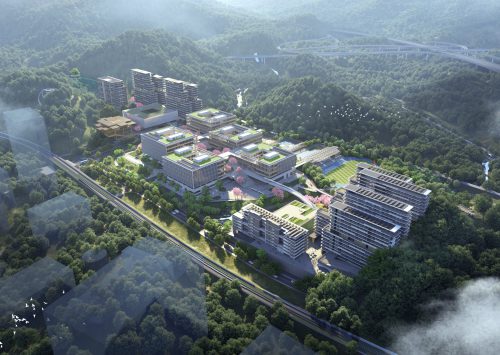
The campus is located in Shenzhen, Guangdong Province, China, with a site area, total building area and population being 16.67 hectares, 190,696 square meters and 3,000 respectively. The building functions include library, student center, classrooms, laboratories, sports halls, student dormitories, canteen and a demonstration center for waste classification, intensive disposal and reuse.
GTSI is a Sino-foreign cooperative educational institution co-founded by the Tianjin University in China and the Georgia Institute of Technology in the United States, with funding from the Shenzhen Government. The project construction strongly responds to the advocacy and policy of carbon neutral in compliance with future main stream aiming to achieve a pilot project of near-zero carbon campus.
The “near-zero” carbon campus project of Georgia Tech Shenzhen Institute, Tianjin University (GTSI), adopts innovative concepts and strategies to achieve low-carbon town construction with full consideration of natural ventilation, daylighting, and shading in the building scheme whilst undertaking high-efficiency energy systems, large-scale renewable energy, advocates low carbon materials, uses innovative technologies such as PEDF (Photovoltaic, Energy storage, Direct current and Flexibility), waste heat reuse and increases carbon sinks through landscape design. Based on these innovative ideas and strategies, the project has received strong support from the Shenzhen Government and the incremental funds for the construction of the project are about 10 million US dollars. Compared with the average energy consumption of campuses in the same climate zone (about 71.7 kWh/m2.year), the project can reduce energy consumption by about 7.18 million kWh per year, reduce carbon emissions by about 3,239 tons per year, and save about 0.96 million dollars per year. The project not only realizes the construction of a near-zero carbon campus but also promotes the concept of green and low-carbon to teachers, students, and society through the practice of green and low-carbon education. During the construction of the project, the gender ratio of construction workers was fully considered, and opportunities were provided for female workers to increase the proportion of husband and wife co-employment. The innovative concept and
strategy of this project will help similar projects in the world to achieve energy conservation and carbon reduction in the construction and operation process.
What is the policy, vision, or objective of the town? Please specify the actual goal and its metrics, if applicable.
Actual goal: as the first batch of near-zero carbon pilot projects in Shenzhen, the project adheres to the principles of low carbon, green, healthy and humanistic design combining the international advanced sustainability guidelines based on the national green and healthy building evaluation standards. It helps the project realize its multiple objectives including ecology, health, comfort and social equity in addition to its primary goal of reducing carbon emissions.
Estimated cost savings in implementing low-carbon measures (per year/per unit of energy, etc.)
Compared with the average energy consumption of campuses in the same climate zone (about 71.7
kWh/m2.year), the project can reduce energy consumption by about 7.18 million kWh per year, reduce
carbon emissions by about 3,239 tons per year, and save about 0.96 million dollar per year.
What central/local government departments are/will be involved in development of the project?
Development and Reform Commission of Shenzhen Municipal – developmental
Urban Planning and Natural Resources Bureau of Shenzhen Municipal – developmental
Bureau of Ecological Environment of Shenzhen Municipal – developmental
Bureau of Public Works of Shenzhen Municipal – implementation
What private company, non-government ogranizations are/will be involved in development of the project?
Georgia Tech Shenzhen Institute,Tianjin University – full participation
China Academy of Building Research – implementation
The Society for Ecological Rehabilitation of Beijing – implementation
Beijing Forestry University – implementation
Shenzhen Boya Building Intelligence Co., Ltd. – implementation
Henn Building Design Consulting (Beijing) Co.Ltd. – implementation
Aube Building Design Co., Ltd. – implementation
A+E Design Co., Ltd. – implementation
Wuzhou Engineering Consulting Group Co., Ltd. – implementation
China Construction Third Engineering Bureau Group Co., Ltd. – implementation
China Railway Construction Engineering Group – implementation
Shenzhen Overseas Decoration Engineering Co., Ltd. – implementation
Chimsen Technology Co.,Ltd. – implementation
How is/will be the development of the town funded?
Based on these innovative ideas and strategies, the project has received strong support and total investment of 248 million US dollars from Shenzhen government.