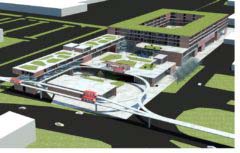
 15-mile bi-directional elevated guideway for local circulation within City of Richmond, California with connections to UC-Richmond Bay Campus, Richmond Amtrak station, Richmond BART station, among the 13 stations. Driverless, solar-powered vehicles seating 8-20 passengers are dispatched on-demand 24 x 7 so that no one should wait more than five minutes to board. Independently-deployed vehicles follow itineraries customized for their riders to reduce intermediate stops and eliminating transfers for direct-to-destination journeys.
Vehicles are not coupled together in a train enabling dramatic reductions in weight that in turn enables the CyberTran® to roll on much more light weight tubular rails on a much more modest supporting structure. The slender Ultra Light Rail Transit (ULRT) guideway with tighter turning radii can be more flexibly routed through dense urban developments for more optimal location of stations. Stations are off-line so that stops are only where patrons are waiting or riders want to get off, allowing other vehicles to operate in express mode on the mainline. System average speed approaches top speed to maximize efficiency and minimize travel times. Empty backhauls and prepositioning are eliminated.
Additional stations may be added without degrading system performance. Harnessing joint development potential defrays station cost, feeding more revenue patronage. Ridership is further enhanced by the convenience of quick, on-demand service encouraging more people to give up driving their own cars.
ULRT is enhanced with Intelligent Transportation Systems (ITS) making use of on-demand vehicle dispatching to increase patronage per dollar of capital investment vis-à-vis traditional schedule-driven transit. Reduction in empty backhauls and intermediate stops increases energy efficiency and asset utilization.
Detailed Information: "Richmond Ultra Light direct-to-destination Rail Transit (ULRT) Demonstration" (Please see the attached file below.)
Project Cost Description
$318,726,000 is an estimate prepared by CyberTran Executive Management together with the City of Richmond in consultation with several architectural and engineering firms. Guideway, stations and vehicles use off-the-shelf components integrated with innovative, yet proven technology.
Emissions Calculations Description
Assuming 4-passenger automobiles that meet 2016 CAFÉ 31.0 mpg and energy equivalent of automobile is .322581 kWhr./seat-mile. This is the ranking applied by U.S. EPA to large passenger sedans – midway between compact cars and light trucks. Given the preponderance of light trucks, which include popular “sport-utility” vehicles, the years required for vehicle fleet turnover, and so adoption of hybrids, all-electrics, and hydrogen-powered cars, it is reasonable to assume mileage for the large passenger car sedan to be a representative average for purposes of this study.
Fuel Displacement Calculations Description
Gasoline savings: Very conservative assumptions – excluding all regional travel and trips from new TOD. See spreadsheet for detailed calculations.
Diesel savings: Very conservative assumptions relying on test run of 60-foot articulated diesel-electric hybrid buses for operation on East Bay BRT.
Solar photovoltaic panels affixed to ULRT guideway, stations and vehicles make system completely self-sufficient. 85% of electricity generated is surplus kWhr. to be fed back into local grid at retail rates. So the reduction by displacement of conventional transit service and mode shift from driving to riding is the net fuel savings. However, surplus solar-generated power fed back into the grid is a third category of “savings” to the surrounding community so it does not have to draw on other, costly and less renewable, sources transmitted from remote generators.